Of the home loan files Nivasa Finance submitted to a lender, 51.4% were disbursed, and the typical family had its money 50 days after first enquiring. Most applications that never reach a lender stop at the very first check. In our data, a low credit score caused 63.3% of credit-related declines, and one in five applicants dropped off on their own side.
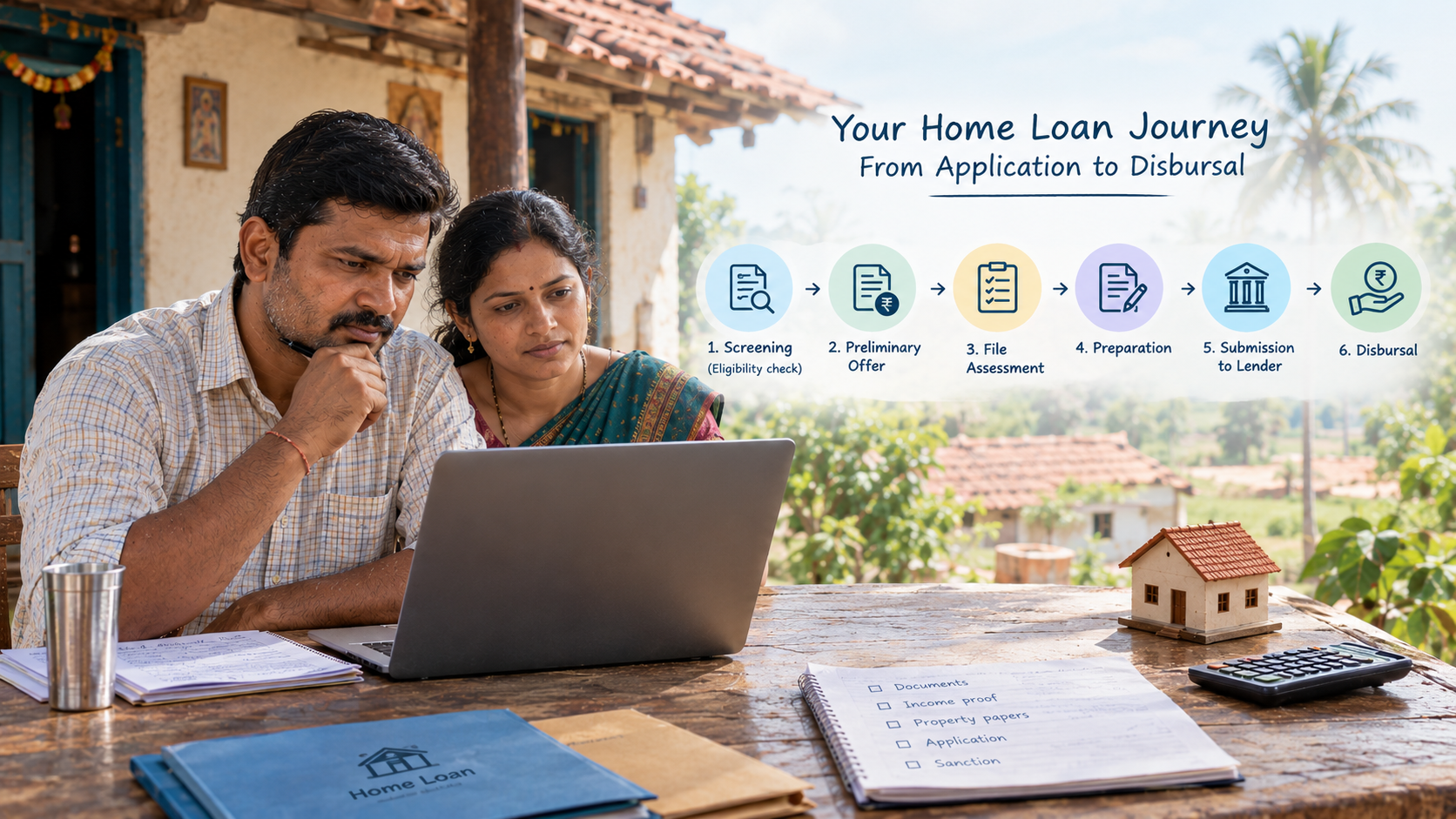
This guide follows real home loan applications through every stage: screening, preliminary offer, file assessment, preparation, submission to a lender, and disbursement. You will see where applications stop, why, and how long each step takes.
Stage figures are based on 15,700 housing loan applications (home loans, loans against property, balance transfers and home renovation) screened by Nivasa Finance across Karnataka between 2 December 2025 and 23 June 2026, each followed for at least 90 days. Timeline figures are based on all 318 such loans disbursed through Nivasa Finance up to September 2026.
- More than half of files sent to a lender are disbursed: 144 of 280 (51.4%).
- Median time from first enquiry to money in your account: 50 days. A quarter of families received it within 32 days.
- 28.2% of screened applicants received a preliminary loan offer, more than 1 in 4.
- Credit score is the biggest barrier: 63.3% of credit-related declines were due to a low score, while property documents caused 6.8%.
- 20.3% of screened applicants dropped off on their own side. That is not a rejection, and they can restart at any time.
What percentage of home loan applications get approved in Karnataka?
The answer depends on where you start counting, so here is every stage. Each percentage is out of the applications that reached the stage before it.
| Stage | What happens | Applications | Moved on from previous stage |
|---|---|---|---|
| 1. Screening | Quick check of income, credit score and property, usually within a day of enquiring | 15,700 | N/A |
| 2. File assessment | A Nivasa expert visits, verifies income and property, and collects documents | 1,743 | 11.1% |
| 3. Pre-lender preparation | File prepared in the lender's format and matched to the right lender | 765 | 43.9% |
| 4. Submitted to a lender | The lender begins its own credit assessment | 280 | 36.6% |
| 5. Disbursed | Lender sanctions the loan and releases the money | 144 | 51.4% |
Source: Nivasa Finance records. 15,700 housing loan applications screened 2 Dec 2025 – 23 Jun 2026, followed for at least 90 days. Some files from the end of this period may still be disbursed later.
Read the table from the bottom up and the picture looks better: once a file reaches a lender through Nivasa Finance, it is more likely to be disbursed than not. Most of the filtering happens at the start, before any lender sees the file, which is why the first stage looks so different from the last.
The loan mix in this group was home loans 56.6%, loans against property 34.2%, balance transfers 8.8% and home renovation 0.4%.
How long does a home loan take in Karnataka?
The median time from first enquiry to disbursement was 50 days. Half of families got their money faster than that, and a quarter within 32 days.
| Step | Median time | Middle half took | Loans |
|---|---|---|---|
| Enquiry → screening | Under 1 day | 0.5 – 1.3 days | 38,260 |
| File assessment → submitted to lender | 11.5 days | 6 – 22 days | 540 |
| Submitted to lender → disbursed | 22 days | 13 – 40 days | 229 |
| Enquiry → disbursed (whole journey) | 50 days | 32 – 77 days | 318 |
Source: Nivasa Finance records, housing loans, applications from September 2024 and disbursals up to September 2026. Step times use only applications with timestamps for both steps, so the steps do not add up to the whole journey.
The step you control most is the middle one. A file reaches the lender faster when your documents are ready and you pick up when the Nivasa expert calls.
Why do home loan applications stop before reaching a lender?
When an application was declined for a credit, income or property reason, this is why:
| Reason | Share of these declines | What you can do |
|---|---|---|
| Low credit score | 63.3% | Clear overdue EMIs and card dues, then reapply. See our guide to a home loan with a low CIBIL score. |
| Income too low or not provable for the amount asked | 29.9% | Ask for a smaller amount, add a co-applicant, or route income through a bank account. |
| Property or documents not meeting lender norms | 6.8% | Get your khata in order, or complete DC conversion for agricultural land. |
Based on 6,056 applications in the same group declined for a credit, income or property reason.
Separately, 20.3% of screened applicants dropped off on their own side. They chose not to continue or could not be reached. That is not a rejection, and anyone in that group can restart. If you were declined, our guide on what to check before you reapply walks through it.
A few terms, in plain words. A credit score (often called a CIBIL score) is a number from 300 to 900 that shows how you have repaid past loans, and our data on what credit score you need for a home loan in Karnataka shows how approval chances change by range. A khata is the property record from your municipality or gram panchayat. DC conversion is the Deputy Commissioner's order allowing agricultural land to be used for a house.
What is a soft offer on a home loan?
A soft offer, also called a preliminary offer, is an early indication after screening of the loan you may be eligible for, based on your income, credit score and property details. It is not a sanction. The final amount and rate are decided only after the lender assesses your full file. In our data, 28.2% of screened applicants received a preliminary offer (4,424 of 15,700).
If you get one, the most useful thing you can do is keep your documents ready and stay in touch with your Nivasa expert, so your file moves to the next stage quickly.
How can you improve your chances of getting a home loan approved?
- Check your credit score before you apply. It is the most common reason applications stop, so clear any overdue payments first.
- Ask for an amount your income can support. Income that is too low for the amount requested is the second most common reason. If your income is in cash or has no ITR, see how lenders assess cash income, self-employed income and farming income.
- Keep your documents ready: ID, income proof or bank statements, and property papers (khata, RTC, sale or partition deed).
- Fix property paperwork early. Get a khata if your property has none, and finish DC conversion before building on agricultural land. Our self-construction home loan guide lists the documents for building on your own land.
- Apply once, through someone who can match you to the right lender, rather than applying to many lenders one after another. Here is how the multi-lender model differs from a direct bank application.
- Stay reachable. One in five screened applications ended with the applicant dropping off.
Once approved, know what you will pay upfront. We break down every home loan charge in Karnataka, and which home loan is right for you helps you pick the product before you apply.
How does Nivasa Finance help your application reach a lender?
Nivasa Finance is a home loan advisor for rural and semi-urban Karnataka. We screen your application, visit you at home, prepare your file, and submit it to a lender in our network of RBI-regulated partner banks and NBFCs whose criteria fit your profile. You pay no commission to Nivasa Finance.
- Loan amounts: ₹5 lakh to ₹50 lakh.
- Products: Home Construction Loan, Home Improvement Loan, Loan Against Home/Property, and Balance Transfer + Top-Up.
- Branches: Mysuru, Mandya, Hassan, Hosapete, Davanagere, Belagavi, Hubballi, Bagalkot, Shivamogga, Raichur and Tumkur, serving 23 districts.
Ready to start? Find your nearest branch or check your eligibility online.