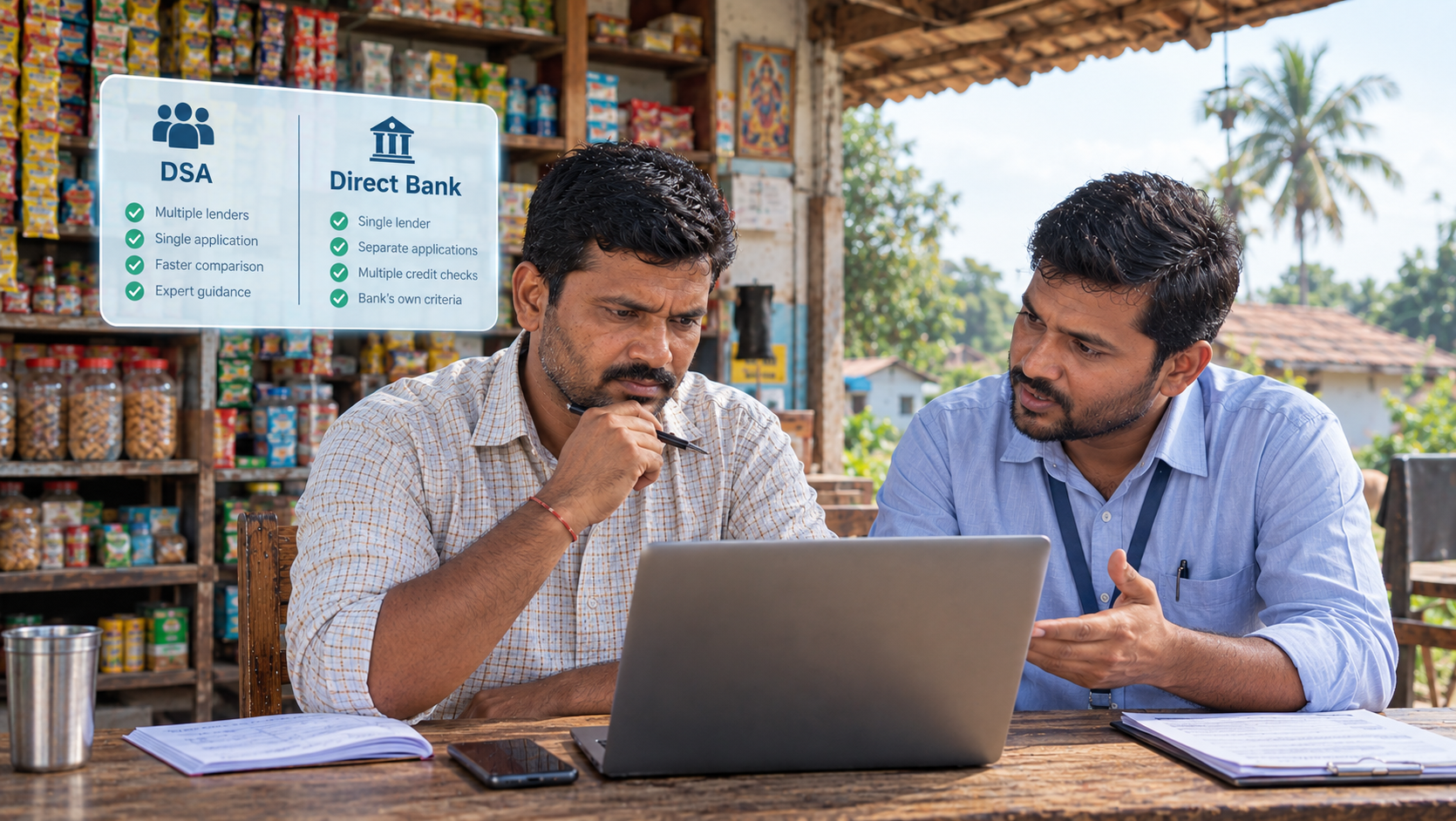
Applying for a home loan through a DSA (Direct Selling Agent) — an intermediary who works with multiple lenders — is structurally different from applying directly to a bank, and the difference matters most when your profile is not straightforward. This article explains what changes, what stays the same, and when each route makes more sense.
What is a DSA — and how is it different from a bank's own sales channel?
A bank's own sales channel — whether a branch, a relationship manager, or an online portal — can only offer you that bank's products, assessed against that bank's internal criteria, at that bank's current rates. If your profile does not fit their underwriting model, you receive a rejection and must start again elsewhere.
A DSA works differently. Instead of representing one lender, a DSA has formal agreements with multiple lenders and presents eligible borrowers to the lender whose product best fits their profile. The DSA's income depends on successful disbursals across that network, not on pushing one institution's product.
As of September 2026, Nivāsa Finance operates as a DSA with a network of more than ten lending partners — banks, Housing Finance Companies (HFCs), and NBFCs (Non-Banking Financial Companies) registered with the Reserve Bank of India (RBI) — across Karnataka.
What actually changes when you apply through a multi-lender DSA?
One intake. Multiple lender assessments.
When you apply directly to three banks, you make three separate applications, submit three sets of documents, and receive three independent decisions. Each application triggers a hard inquiry on your credit report. Multiple hard inquiries in a short window can reduce your CIBIL score — the three-digit credit score, ranging from 300 to 900, used by most lenders to assess repayment risk.
When you apply through a multi-lender DSA, a single intake — one document set, one credit assessment — can be evaluated against multiple lenders simultaneously. Your file is directed to the lender most likely to approve it on suitable terms, rather than whoever you happened to walk into first.
Eligibility is assessed before the application, not after.
A bank's front-end staff are usually not the people making credit decisions. They collect documents and send them upstream. Problems — a khata issue, an income documentation gap, a property title concern — surface weeks later, after the file has already moved through several internal stages.
A DSA with working knowledge of multiple lenders' current criteria typically identifies these issues at the pre-screening stage: which lenders are accepting your property type in your area, which will consider non-standard income documentation, and which have faster turnaround for your loan size. The assessment happens at the front, not after a formal submission.
Lender selection is matched to your profile — not the other way around.
Different lenders price risk differently and serve different borrower segments. A borrower with a moderate CIBIL score, a self-constructed rural property, and business income may be outside the underwriting appetite of an institution focused on salaried urban applicants, but is a standard case for an HFC or NBFC that specialises in that segment.
A multi-lender DSA with current knowledge of each partner's appetite can route your file to the right institution. This does not guarantee approval — no intermediary can — but it means your application reaches a lender whose criteria actually fit your profile.
Can you get a home loan for a B-Khata or panchayat (Form 9) property?
Khata is the municipal or panchayat record of a property's tax status and legal standing in Karnataka. A-Khata means the property fully complies with local building and zoning rules. B-Khata means there is an unresolved compliance gap — typically a missing construction approval — and mainstream banks generally will not lend against it. E-Khata is simply the digital version of either record and does not by itself change a property's legal status. Form 9, used for properties outside municipal limits in gram panchayat areas, is the rural equivalent of an A-Khata rather than a problem category — a Form 9 property can be fully legal — but many banks are still reluctant to finance panchayat-jurisdiction properties because valuing and reselling rural land is harder for them to standardise.
This is exactly the kind of property a multi-lender DSA exists for. A Form 9 panchayat property is often financeable through an HFC or NBFC that routinely works in rural Karnataka, even when it would not clear a public-sector bank's standard checklist. A B-Khata property carries a real compliance gap that no lender can waive, but a multi-lender assessment will tell you plainly whether any partner in the network is willing to finance it and on what terms, rather than a single rejection with no explanation.
Direct to bank vs multi-lender DSA — what differs
| Factor | Direct to bank | Multi-lender DSA |
|---|---|---|
| Lenders assessed | One per application | 10+ from one intake |
| Credit inquiries | One per bank approached | One, shared across relevant partners |
| Pre-screening | After documents submitted | Before any application is filed |
| Lender fit | Borrower adapts to lender | Lender matched to borrower profile |
| Non-standard profiles | Higher chance of mismatch | Routed to specialist lenders |
| Document support | Borrower manages | DSA assists with preparation |
| Cost to borrower | Lender fees only | Lender fees only (DSA paid by lender) |
| Post-disbursal relationship | With the bank directly | With the lender directly |
What stays the same regardless of which route you take?
The loan itself comes from the lender, not the DSA. Once sanctioned and disbursed, your relationship is with the lending institution: you pay EMIs to them, they hold the title documents, and any prepayment or restructuring goes through them.
The rate you receive, the LTV (Loan-to-Value ratio — the proportion of the property value a lender will finance), and the legal and technical assessment of your property are all the lender's decisions. A DSA can present your file well and ensure it reaches the right institution, but cannot override a lender's credit policy or valuation norms.
The DSA's role ends at disbursement.
Does applying through a DSA cost more?
No — at least it should not. A DSA is compensated by the lender on successful disbursement, typically as a percentage of the disbursed loan amount. The borrower does not pay the DSA for submitting an application.
When does a direct bank application make more sense?
If your profile is clean and straightforward — salaried income with payslips, A-Khata or e-Khata urban property, strong CIBIL, and an existing relationship with a lender that has a competitive product — applying directly to that institution is reasonable.
Direct to bank may suit you if:
- Salaried with documented payslips
- A-Khata or e-Khata urban property
- CIBIL score above 750
- Existing customer of a bank with a competitive rate
- Standard loan amount and tenure
A multi-lender DSA adds more value if:
- Self-employed, business, or cash income
- B-Khata, Form 9, or rural panchayat-area property
- Thin or no credit history
- Previous application was rejected
- Self-construction or mixed land and build project
The multi-lender DSA route earns its value when something in your profile sits outside the mainstream. These are the cases where lender selection makes a material difference to the outcome.
What should you expect from Nivāsa Finance?
As of September 2026, Nivāsa Finance operates eleven branches across Karnataka, covering more than 20 districts, with staff who work primarily on rural and semi-urban home loan files.
| Branch | Districts served |
|---|---|
| Mysuru | Mysuru, Chamarajanagar |
| Mandya | Mandya, Ramanagara |
| Hassan | Hassan, Chikkamagaluru |
| Hosapete | Ballari, Vijayanagara, Koppal |
| Davanagere | Davanagere, Chitradurga |
| Belagavi | Belagavi |
| Hubballi | Dharwad, Haveri, Gadag |
| Bagalkot | Bagalkot, Vijayapura |
| Shivamogga | Shivamogga |
| Raichur | Raichur, Yadgir |
| Tumkur | Tumkur |
The process at each branch typically runs as follows:
- Pre-assessment — income, property type, and credit profile reviewed before any application is filed or credit check run.
- Lender matching — your file is mapped to the partners in the network whose current criteria fit your profile and geography.
- Document preparation — assistance with compiling the document set, identifying gaps, and coordinating property paperwork.
- Application and follow-up — submission to the selected lender, with a single point of contact tracking status through sanction.
- Disbursal support — coordination through the final legal and technical steps until funds are released.
What you should not expect: a guaranteed outcome, a rate that beats every lender in the market in every case, or a process that bypasses the lender's own legal and technical requirements. Those apply regardless of the channel.
If your profile fits one of the cases above, you can check your eligibility for a home loan with Nivāsa Finance directly, or find your nearest branch to talk through your specific documents in person.
Related pages on nivasafinance.com
- Home Loan Rejected? What to Check First — when a direct application fails, what to review on credit, income, and property before trying again
- Home Loans for Cash Income and Self-Employed Borrowers — the income segment where lender selection makes the biggest difference
- Self-Construction Home Loans in Karnataka — why most self-build files need an HFC rather than a public sector bank
- Nivāsa Finance Mysuru Branch — serving Mysuru district and surrounding talukas